March 13, 2025
Studies have shown that up to 50% of domesticated horses in the United States are overweight and anywhere between 15% to 30% are obese. With obesity comes equine metabolic syndrome, insulin resistance, arthritis, and other harmful conditions.
For owners who are looking to help their animals achieve a healthier score on the Henneke body condition scoring chart, there are options. As always, the conversation should start with an equine veterinarian or nutritionist to pinpoint what’s missing or overabundant in each horse’s diet.
If you’re considering asking them about supplements for overweight horses, you might want to ask about Total Equine, which is made in part with our Ascophyllum nodosum seaweed. You might be thinking, “Can horses eat seaweed?” Absolutely, and they receive several health and wellness benefits from this marine resource too.
In fact, here’s what two trials conducted by researchers at Sul Ross State University found regarding the impact of feed rations containing seaweed on the body composition and feed intake of horses.
Reducing Horse Body Composition Scores and Feed Intake
Under the guidance of Dr. Jaime Boyd, Associate Professor and Program Coordinator Animal Science at Sul Ross State University, researchers conducted two tests that offered answers about the positive impact on equine dietary health.
In one study, researchers conducted a six-month trial evaluating the impact of different horse feeds when paired with Bermuda hay. Horses were fed hay ad libitum (without any restrictions) and their standard feed during the control phase of the trial compared to Total Equine (which includes our feed supplements) in the trial phase.
At the end of the study, each equine was measured for body weight change, body fat content, body lean mass content, and body condition score. The results? In both the trial and control phases horses lost weight, but the body fat and lean mass changes varied.
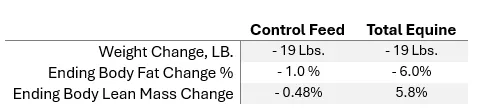
Moreover, the test group made progress to a healthier Henneke body condition score, shifting from 7 (fleshy) to a 6.8 (nearing moderately fleshy).
In the second study, researchers conducted an eight-week trial to test the effectiveness of a horse feed’s ability to control feed intake. Horses in this trial were again fed Bermuda hay with their standard feed and Total Equine with their control with the feeding rate adjusted weekly according to body weight.
The results of the study demonstrated a decrease in weight and in hay intake during the test phases of the study.

What to Know Before Using Supplements for Overweight Horses
The Total Equine trials offered some promising findings. Though the number of horses included in both trials was relatively small, there is enough potential in these findings to merit further study.
Proper nutrition is essential to the overall health and well-being of horses, and feed containing nutrients and organic compounds found in seaweed can make a big difference. Again, you always want to consult your equine veterinarian for all your dietary needs, but the right amount of brown seaweed may help in your efforts to help your horses shed unhealthy fat.